
What is Subnetting and Subnet Mask? A Complete Guide to Network Segmentation
Friday, January 9, 2026
In today's interconnected digital landscape, efficient network management is crucial for organizations of all sizes. Whether you're managing a small office network or overseeing a global enterprise infrastructure, understanding subnetting and subnet masks is essential for creating secure, scalable, and well-organized networks.
Subnetting and subnet masks are fundamental concepts in network administration that often seem complex to beginners but become invaluable once mastered. They allow network administrators to divide large IP address spaces into smaller, manageable segments while optimizing bandwidth usage and improving security. If you're preparing for networking certifications, building your first network, or looking to deepen your technical knowledge, this guide will demystify these critical networking concepts.
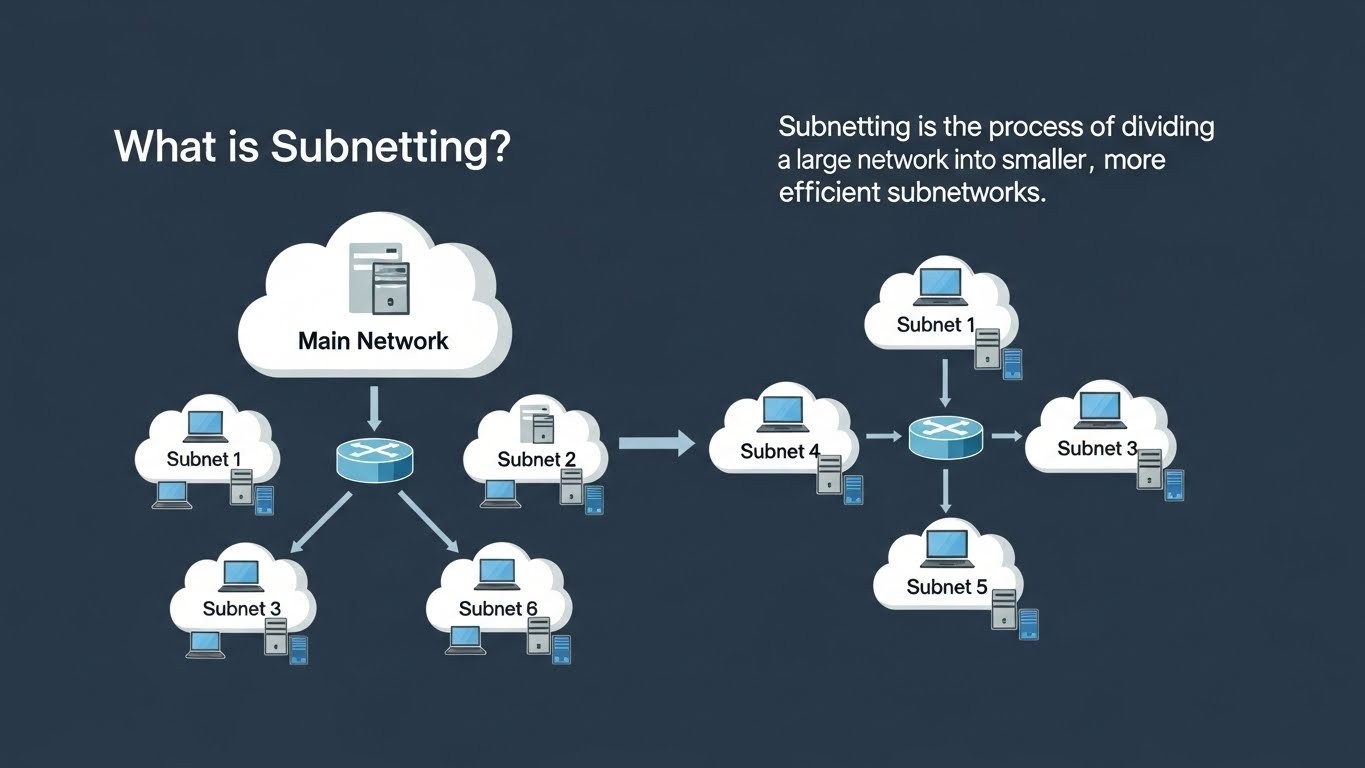
What is Subnetting?
Subnetting is the process of dividing a larger IP network into smaller, more manageable subnetworks (subnets). This division allows network administrators to create logical segments within their infrastructure, improving organization, security, and resource allocation.
Think of subnetting like dividing a large city into districts. Each district has its own services, governance, and communication patterns, but all districts remain part of the larger city. Similarly, subnets remain part of the larger network but function as independent units with their own characteristics.
Why Subnetting Matters
Organizations use subnetting for several critical reasons:
Improved security: Isolate sensitive departments or systems from general network traffic
Better performance: Reduce broadcast traffic and network congestion by limiting the scope of broadcasts
Efficient IP address usage: Maximize the utility of available IP addresses by allocating only what's needed to each subnet
Simplified network management: Make it easier to manage, troubleshoot, and scale network infrastructure
Enhanced network control: Implement different routing policies and access controls for different segments
Understanding Subnet Masks
A subnet mask is a 32-bit number that works in conjunction with an IP address to determine which portion of the IP address represents the network and which portion represents individual devices (hosts).
How Subnet Masks Work
IP addresses consist of two parts: the network address and the host address. The subnet mask acts as a filter that identifies these two components.
A subnet mask uses binary notation (ones and zeros), where:
1s represent the network portion of the address
0s represent the host portion of the address
For example, the subnet mask 255.255.255.0 in binary is: 11111111.11111111.11111111.00000000
This indicates that the first three octets (24 bits) identify the network, while the last octet (8 bits) identifies individual hosts on that network.
Common Subnet Masks
Understanding standard subnet masks helps you quickly recognize network configurations:
255.255.255.0 (/24): Allows 254 usable host addresses
255.255.255.128 (/25): Allows 126 usable host addresses
255.255.255.192 (/26): Allows 62 usable host addresses
255.255.255.224 (/27): Allows 30 usable host addresses
255.255.255.240 (/28): Allows 14 usable host addresses
The "/24" notation (CIDR notation) indicates how many bits are used for the network portion, providing a shorthand way to represent subnet masks.
The Relationship Between IP Addresses and Subnet Masks
An IP address and its corresponding subnet mask work together to define a network's boundaries. When combined, they tell devices whether another IP address is on the same local network or requires routing through a gateway.
Practical Example
Consider the IP address 192.168.1.100 with a subnet mask of 255.255.255.0:
IP Address: 192.168.1.100
Subnet Mask: 255.255.255.0
Network Address: 192.168.1.0
Broadcast Address: 192.168.1.255
Usable Host Range: 192.168.1.1 through 192.168.1.254
Any device with an address in the 192.168.1.0 to 192.168.1.255 range belongs to this subnet. Devices outside this range require a router to communicate.
CIDR Notation: A Modern Approach
Classless Inter-Domain Routing (CIDR) notation simplifies subnet mask representation by using a forward slash followed by the number of bits allocated to the network.
Instead of writing "IP address 192.168.1.100 with subnet mask 255.255.255.0," you can write "192.168.1.100/24." This concise notation is now standard in modern networking and appears frequently in networking configurations and documentation.
Classes of IP Addresses and Default Subnet Masks
Historically, IP addresses were divided into classes with default subnet masks. While classless addressing (CIDR) has largely replaced this system, understanding it provides valuable context:
Class A: Default mask /8 (255.0.0.0) - supports millions of hosts
Class B: Default mask /16 (255.255.0.0) - supports thousands of hosts
Class C: Default mask /24 (255.255.255.0) - supports 254 hosts
Class D: Reserved for multicast
Class E: Reserved for experimental use
Most modern networks use CIDR notation instead of these classes, allowing for more flexible address allocation.
Calculating Subnets: A Practical Guide
Subnet calculation becomes intuitive with practice. The key formula is:
Number of usable hosts = 2^(number of host bits) - 2
The "-2" accounts for the network address and broadcast address, which cannot be assigned to individual devices.
Quick Calculation Example
For a /26 subnet mask:
Total bits for hosts: 32 - 26 = 6 bits
Usable hosts: 2^6 - 2 = 62 host addresses
This means each /26 subnet can support up to 62 individual devices.
Real-World Subnetting Applications
Large Enterprise Networks
Enterprises divide their infrastructure into multiple subnets by department. Finance, HR, Development, and Production each receive appropriately sized subnets, enhancing both security and performance.
ISP Infrastructure
Internet Service Providers use subnetting to efficiently allocate address space to customers, allocate resources, and manage routing.
Cloud Environments
Cloud providers use sophisticated subnetting strategies to isolate customer environments, manage resource allocation, and optimize network performance across their infrastructure.
Small Business Networks
Even small businesses benefit from basic subnetting by separating guest networks from employee networks and protecting sensitive systems from general traffic.
Key Takeaways for Networking Professionals
Subnetting divides networks into logical segments that improve security, performance, and management
Subnet masks determine which portion of an IP address represents the network versus the host
CIDR notation provides a modern, efficient way to express subnet masks and network ranges
Proper subnet planning prevents address conflicts and supports future network growth
Understanding subnetting is essential for network design, troubleshooting, and administration
Conclusion
Subnetting and subnet masks are not just theoretical concepts—they're practical tools that every networking professional must master. These fundamental skills enable you to design efficient networks, troubleshoot connectivity issues, and implement robust security policies.
As you continue your networking journey, remember that subnetting provides the framework for building scalable, secure, and manageable networks. Whether you're studying for a certification, managing a corporate network, or working in IT operations, the principles outlined in this guide will serve you well.
Start practicing subnet calculations, experiment with different mask configurations in your lab environment, and gradually build the intuition that comes with hands-on experience. Your investment in understanding these concepts will pay dividends throughout your IT career.

The founder of Network Kings, is a renowned Network Engineer with over 12 years of experience at top IT companies like TCS, Aricent, Apple, and Juniper Networks. Starting his journey through a YouTube channel in 2013, he has inspired thousands of students worldwide to build successful careers in networking and IT. His passion for teaching and simplifying complex technologies makes him one of the most admired mentors in the industry.